Heart Attacks, Missile Strikes, and a Sister's Death: Wrestling's Heaviest Week in Recent Memory
Some weeks, wrestling is escapism. This was not one of those weeks. Between Andrade’s haunting recollection of watching Ric Flair’s heart give out in real time, the surreal news of a missile strike near the Crown Jewel venue after WWE’s roster had already left Saudi Arabia, and Mercedes Moné quietly revealing the death of her younger sister, the industry spent more time confronting mortality than it did building toward pay-per-views. That’s worth sitting with before we get into championship changes and retirement timelines.
The Andrade Story Is One of the Most Chilling Things You’ll Hear All Year
There is a particular horror baked into Andrade’s account on Talk Is Jericho of watching Ric Flair suffer a heart attack during his final match — and it has nothing to do with incompetence or negligence on Andrade’s part. It has everything to do with what professional wrestling trains its performers to believe: that selling is the craft, that the drama is manufactured, and that when a 73-year-old legend starts struggling, the first instinct is to wonder whether he’s working you. Andrade’s admission that he initially thought Flair was playing to the crowd isn’t embarrassing — it’s a window into how deeply the psychology of this business rewires your instincts as a performer.
That rewiring has a cost. The fact that in-ring performance can so convincingly mimic physical distress is part of what makes wrestling compelling, but it also means the people closest to a crisis might be the last ones to recognize it as one. Andrade was Flair’s son-in-law at the time and was sharing the ring with him. If he needed a moment to distinguish performance from cardiac emergency, imagine what it looked like to everyone watching from a distance. This story doesn’t have an obvious villain or a clean lesson. It’s just an uncomfortable truth about an art form that has always danced uncomfortably close to genuine danger.
What it also does, unintentionally, is reframe the debate around Flair’s final match in Nashville. The criticism of that event — Flair’s age, the physicality involved, the legitimacy of the sanctioning body — tends to be discussed in the abstract. Andrade puts a human face on those abstract concerns and grounds them in a specific, terrifying moment. That conversation deserves to continue.
The Saudi Arabia Missile Story Demands More Accountability Than It’s Getting
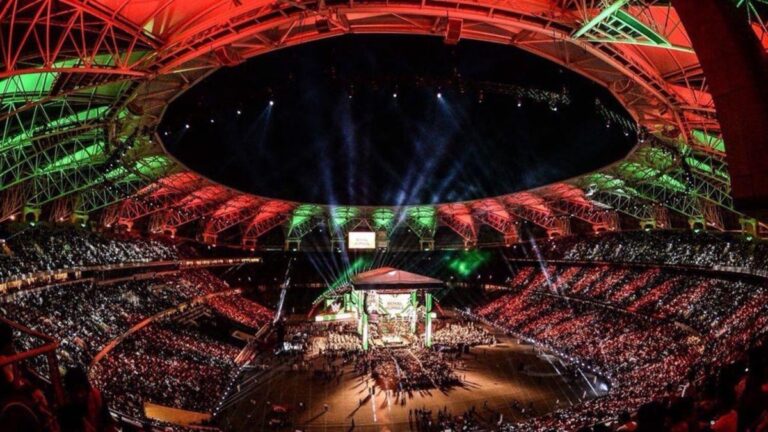
Let’s not let this one slide quietly into the news cycle. A missile struck the King Abdullah Financial District in Riyadh one day after WWE Crown Jewel, and the primary framing of that story — in multiple outlets, not just this one — has been a variation of “everyone was already home safe.” That framing is a form of narrative closure that the situation doesn’t necessarily warrant. The roster being out of the country before the strike happened is genuinely good news. It is not, however, the full story, and treating it as such quietly buries the more uncomfortable question underneath it.
WWE has staged enormous events in Saudi Arabia for years under its partnership with the Saudi government, bringing hundreds of performers, production staff, and crew into a region that geopolitical reality repeatedly reminds us carries real security risk. The question of whether that risk is adequately disclosed to talent, whether talent has genuine recourse if they don’t want to participate, and whether the financial calculus at the corporate level accounts for more than logistics — these are not new questions. They resurface every time something like this happens, and they tend to disappear again once the news cycle moves on. The fact that the roster departed safely doesn’t resolve the structural concern.
WWE will return to Saudi Arabia. That’s essentially a certainty given the scale of the existing deal. When they do, this week’s news should be part of the conversation that talent, management, and observers have about what that relationship actually costs — not in dollars, but in exposure.
Mercedes Moné Deserved Better Than a Newsletter
Mercedes Moné revealed in her Moné Mag newsletter that her younger sister Alexis Varnado passed away in September, leaving behind two young children. That news broke quietly, buried in a week full of pay-per-view buildup and title changes. The AEW Women’s World Champion has been performing, promoting, and showing up to television tapings for weeks while carrying this privately, and the fact that it came out through a personal newsletter rather than any kind of public acknowledgment from the company she works for says something — though I’m not entirely sure what.
There are arguments for respecting a talent’s privacy and letting them control the narrative around personal tragedy on their own terms. Moné clearly chose to share this herself, in her own space, in her own words, and that agency matters. At the same time, it’s worth noting the contrast: when AEW talent achieve things, the company is very good at making noise. When they grieve, the machinery goes quiet. Neither approach is inherently wrong, but the asymmetry is noticeable.
What I do know is that Moné has been one of the most heavily criticized figures in wrestling over the past year — for her contract situation, for her in-ring output relative to her pay, for the perception that she’s been protected creatively. All of that criticism can be legitimate and coexist with the basic human acknowledgment that she has been doing her job while mourning a sibling. Those two things are not in conflict. The industry would do well to remember that more often.
Ciampa Winning the AEW National Title Is the Right Call at the Right Time
Stepping back from the heavier material: Tommaso Ciampa dethroning Andrade El Idolo for the AEW National Championship on Collision is exactly the kind of booking decision AEW needs to be making more consistently right now. Ciampa is a credible, experienced performer who had already built a compelling narrative around this feud after coming up short at WrestleDream. The rematch delivered a different result, and the story has an organic logic to it that too many AEW title programs lack. It’s also worth acknowledging that Andrade El Idolo, the man he beat, is currently getting attention in a very different context — his Talk Is Jericho appearance this week arguably generated more column inches than any match he’s had in AEW this year.
Ciampa as a champion gives AEW a workhorse titleholder who can work a variety of styles, deliver on television, and credibly defend against challengers from multiple parts of the roster. The National Championship has historically been something of a secondary concern in AEW’s hierarchy — the question now is whether the company commits to making Ciampa’s reign mean something beyond the initial pop of the title change. His track record in NXT suggests he knows exactly how to make a championship feel important through sheer consistency of effort. AEW should trust him to do the same thing here and give him the material to work with.
This one felt like a small but meaningful sign that Collision is finding its identity as a show that rewards investment and builds toward conclusions, rather than just setting up the next Dynamite. More of this, please.
The Ospreay-Fletcher Confrontation and Copeland’s Last Chapter Are AEW’s Most Compelling Stories Right Now
Going into Full Gear, AEW has two matches that actually feel genuinely loaded with narrative weight. The face-to-face between Will Ospreay and Kyle Fletcher ahead of their AEW World Championship match is the culmination of a mentor-student dynamic that the company has been cultivating for the better part of the year, and the November 11 special is the right venue to let that confrontation breathe before the match itself. Fletcher turning on the people he came up with is the oldest story in wrestling, but Ospreay makes it land because he’s one of the few people on earth who can make you simultaneously believe in his invincibility as a champion and his genuine emotional investment in what Fletcher’s betrayal means to him.
The Copeland-Okada match for the AEW International Championship carries different weight entirely. Booker T’s reaction to Copeland’s announced 2027 AEW retirement keeps the conversation about how much longer Copeland should be working at this level in the foreground, and that’s not necessarily a bad thing — it adds a layer of urgency to every match he has between now and whenever he actually walks away. Okada defending the International title against Copeland at Full Gear is a clash of two performers at wildly different stages of their careers and bodies, and that asymmetry, if AEW frames it correctly, could make for genuinely compelling television storytelling heading into the pay-per-view. The key is not letting Copeland’s retirement timeline become a crutch that telegraphs outcomes. Let the match exist on its own terms first.
This was a week that kept asking the same question in different registers: what does it cost to do this job, and who pays? Andrade paid with the memory of a moment that should never have happened. WWE talent paid with proximity to a missile strike in a country their employer has financial reasons to keep returning to. Mercedes Moné paid with grief she kept mostly private while the cameras kept rolling. Ciampa and Ospreay and Fletcher and Copeland are out there building something in AEW that, at its best, reminds you why any of this is worth caring about. Hold both things. The spectacle and the cost. That’s the only honest way to watch professional wrestling in 2026.